Specs that survive the session
Turn ephemeral AI plans into persistent, resumable specs built through deep research and iterative interviews. Pick up exactly where you left off.
From idea to implementation, nothing lost along the way
Every spec goes through a disciplined research-first workflow. No guessing, no premature code, no lost context.
Deep Research
Exhaustive codebase analysis, library comparisons, documentation lookups, web research. A dedicated subagent reads 15-30 files and runs parallel searches.
Interview
Targeted questions informed by research findings. Architecture decisions, scope boundaries, acceptance criteria. Iterates until no ambiguity remains.
Write Spec
Structured SPEC.md with phases, tasks, architecture diagrams, library choices, testing strategy, and a decision log. Self-reviewed before presenting.
Implement
Task-by-task execution with live progress tracking, verification gates, and phase reviews. Resume context lets you pick up exactly where you stopped.
Four variants, one workflow
Pick your output format and your methodology. Markdown for friction-free git workflows, or rich HTML with Mermaid diagrams, syntax-highlighted code diffs, and clickable mockup library. With or without strict test-driven development.
Standard · Markdown
The research-first workflow producing SPEC.md files. Plain markdown, git-friendly diffs, opens anywhere.
- Deep researcher subagent, library comparisons, architecture notes
- Phase/task tracking, resume context, multi-spec switching
- Universal skill — natural-language triggers, works in every AI tool
Standard · Rich HTML
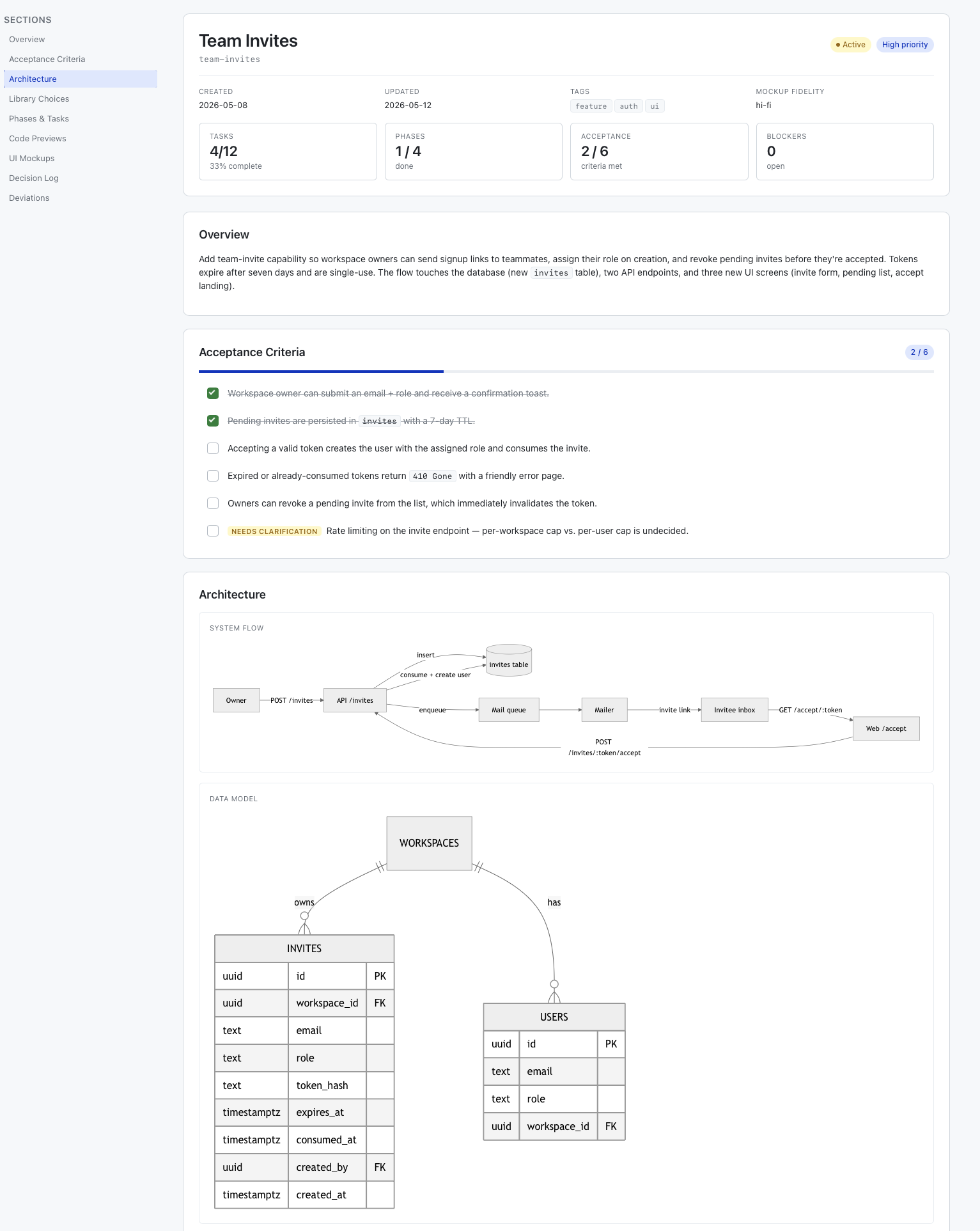
Same workflow, SPEC.html output. Mermaid diagrams, PrismJS code diffs, wireframe and hi-fi UI mockups, click-to-zoom.
- Mermaid flowchart, sequence, ER, state, journey, treemap
- PrismJS diff-highlight: red/green lines with syntax color
- Bespoke
.wf-*/.ui-*mockup primitives - Derived progress — one
data-statusswap propagates
Test-Driven · Markdown
Core workflow plus strict red-green-refactor enforcement. Every task starts with a failing test.
- Alternating TEST-IMPL task pairs per phase
- Mandatory test runs at RED, GREEN, REFACTOR transitions
- TDD Log audit trail; Testing Architecture in every spec
- Language-agnostic testing reference for 6+ languages
Test-Driven · Rich HTML
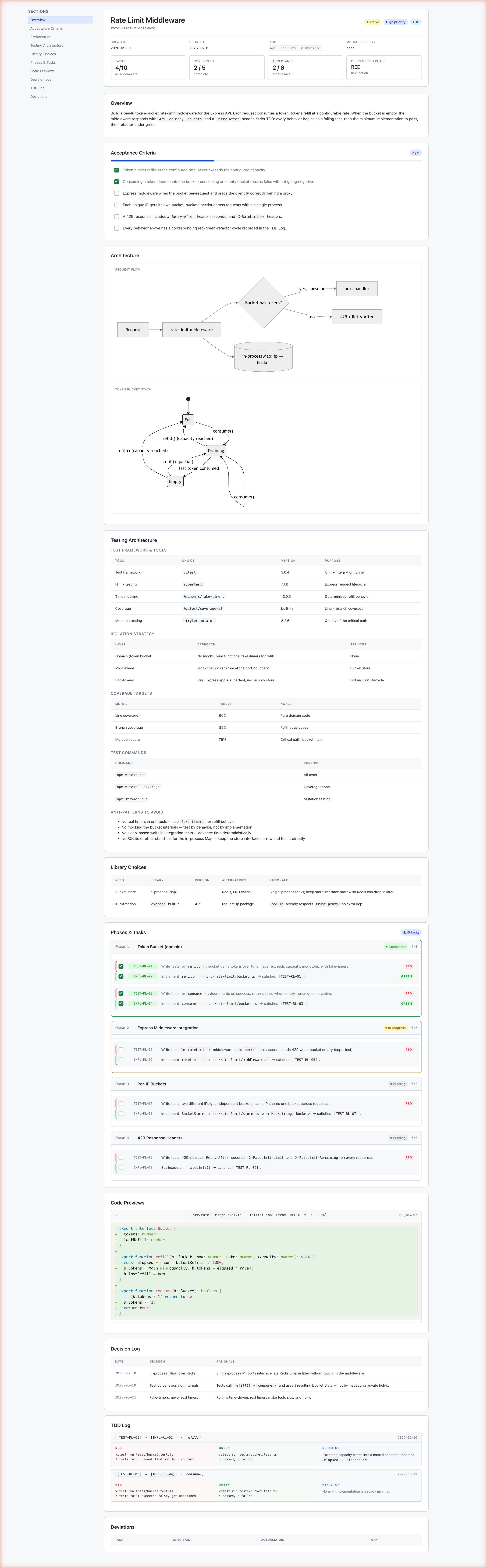
TDD discipline rendered as a 3-lane RGR swimlane log, paired TEST-IMPL task cards, click-to-zoom diagrams.
- RED / GREEN / REFACTOR swimlane TDD log per cycle
- Paired TEST-IMPL task cards with
satisfiescross-refs - Current TDD phase derived live from the in-progress IMPL task
- Same HTML rendering stack as
specmint-core-html
Specs that look like specs, not READMEs
The -html variants emit a single SPEC.html file with the design system baked in. Click a preview to open it full size.
Real files, not ephemeral plans
Every spec lives in a .specs/ directory as plain markdown. Browse, edit, diff, commit — they're just files.
Juggle multiple specs without losing context
Forge a spec, pause it, start another, implement a few phases, switch back. Every spec remembers exactly where you stopped.
Core vs TDD at a glance
TDD builds on Core. Everything in Core is also in TDD — the TDD column shows what it adds. The -html suffix is orthogonal: same workflow, the only thing it changes is the output format from markdown to rich HTML.
| Feature | Core | TDD |
|---|---|---|
| Research → Interview → Spec → Implement | ✓ | ✓ |
| Deep researcher subagent | ✓ | ✓ |
| Architecture diagrams & library comparisons | ✓ | ✓ |
| Resume context & registry tracking | ✓ | ✓ |
| TUI progress tracking & verification gates | ✓ | ✓ |
| Phase-level review & self-review checklist | ✓ | ✓ |
| Cross-tool support (Codex, Cursor, Windsurf, Cline, Gemini, Devin, Antigravity, and others) | ✓ | ✓ |
| Alternating TEST-IMPL task pairs per phase | — | ✓ |
| Strict red-green-refactor enforcement | — | ✓ |
| TDD Log audit trail | — | ✓ |
| Testing Architecture section in specs | — | ✓ |
| Testcontainers & isolation strategy | — | ✓ |
| Language-agnostic testing reference | — | ✓ |
Up and running in one command
Install as a universal skill — one command, any AI coding tool.
npx skills add ngvoicu/specmint-tdd -g
npx skills add ngvoicu/specmint-tdd-html -g
Speak the magic words
Talk to your AI tool in plain language. The skill recognizes the spec lifecycle and triggers the right workflow.


The knowledge your repo can’t tell you.
Specmint reads your codebase. Kluris gives your agents the other half — tribal knowledge that never made it into comments. Decisions, constraints, past incidents, who owns what. Curated. Versioned. Queryable.
Grounded research
Phase 1a reads the repo. Phase 1b queries the brain. Specs land with decisions, not guesses.
Institutional memory
Architecture calls, migration scars, stakeholder context. Survives team turnover and agent resets.
Spec reuse
Harvest reusable patterns from shipped specs back into the brain. The next feature starts smarter.
> write a spec for OAuth sign-in with GitHub —
  check the brain, the codebase, and the web

research · phase 1a · reading codebase ........ done
research · phase 1b · kluris wake-up ........... done
research · phase 1c · synthesis ............... done

> spec written to .specs/oauth-github.md — ready for interview.
pipx install kluris
Explore Kluris →